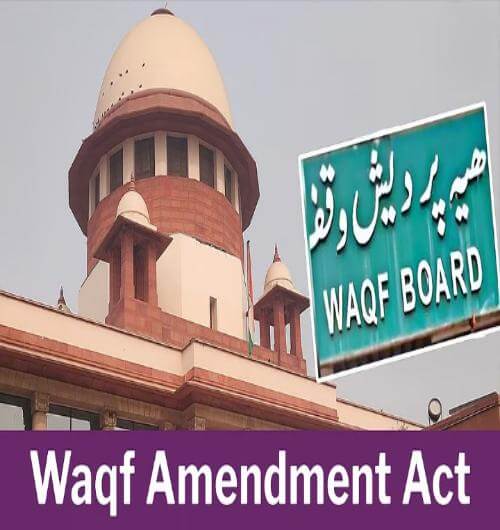
Supreme Court Puts Partial Brake on Waqf Amendment Act, 2025
The Supreme Court on Monday stayed select provisions of the Waqf (Amendment) Act, 2025, while refusing to halt the entire amendment.
A Bench led by Chief Justice BR Gavai and Justice Augustine George Masih held that certain clauses were problematic but clarified that its order is only interim and prima facie in nature.
Key Highlights of the Court’s Order:
-
5-year Muslim practice rule stayed: Section 3(r), requiring a person to be a practicing Muslim for five years before dedicating property as waqf, has been stayed until rules are framed to check compliance.
-
Collector’s role curbed: Proviso to Section 3C, which empowered the Collector to adjudicate waqf declarations, stayed as it violated the separation of powers.
-
Registration stays: The requirement of registering waqf properties remains valid, as it already existed in earlier laws.
-
Ex-officio appointments: Section 23 not stayed, but Court directed that the Chief Executive Officer of a Waqf Board should, “as far as possible,” be a Muslim.
-
Non-Muslim members capped: Central Waqf Council cannot have more than 4 non-Muslims (of 22), and State Waqf Boards not more than 3 non-Muslims (of 11).
-
Waqf-by-user protected: Although “waqf-by-user” has been deleted from the law, existing waqf properties cannot be altered without Tribunal and High Court oversight.
-
Other provisions upheld: Court refused to stay Sections 3D (removing waqf status for ASI monuments), 3E (excluding tribal lands), and deletion of Section 104 (earlier allowed non-Muslims to create waqfs).
The Bench emphasized that these directions are temporary safeguards, and the validity of the Act will be examined in detail at the final stage.